
Why some sidewalk repairs fail
A strong surface cannot compensate for weak concrete beneath it
One of the most important factors in concrete sidewalk restoration is the condition of the original concrete beneath the repair. In some conventional repairs, approximately two inches of deteriorated concrete are removed and replaced with a high-performance cementitious repair mortar. Initially, the result may look excellent: a new surface that is strong, smooth and resistant.
However, even a premium repair material cannot guarantee long-term performance when the underlying concrete is already severely deteriorated. Water enters through cracks, joints and edges; when susceptible concrete becomes saturated and goes through repeated freeze-thaw cycles, internal damage progressively develops.
In severe cases, the original concrete loses cohesion and becomes weak, friable or granular. It may crumble beneath a repair layer that itself remains sound — until it loses its support.
The new repair may remain strong while the deteriorated concrete beneath it continues to lose integrity.
Signs the concrete beneath the surface is weakened
- The repair layer is lifting (delamination)
- New cracks in the restored surface
- Localized fragments breaking off
- Hollow sound when the surface is tapped
- Crumbling edges
- Repairs needed again after a few winters
This is why a proper assessment of the existing concrete is essential before selecting a repair method.
Three approaches
Crack repair, partial-depth or full-depth?
All three methods have their place. The right one depends on how deep the deterioration goes — not on how the surface looks.
Crack repair
- What we do
- Treatment of the crack and surrounding concrete: cementitious materials, compatible resin systems or flexible joint treatment.
- When it is appropriate
- Stable crack and sound surrounding concrete.
- What to watch
- When cracking indicates extensive deterioration, crack filling alone is not enough.
- Cost
- Lowest.
Partial-depth repair
- What we do
- Approximately two inches of deteriorated concrete removed and replaced with a high-performance repair mortar.
- When it is appropriate
- When the remaining concrete is sufficiently sound.
- What to watch
- If deterioration goes deeper, weakened concrete stays under the new layer: delamination, cracking, repeated repairs.
- Cost
- Lower initial cost; can become less economical over time.
Full-depth restoration
- What we do
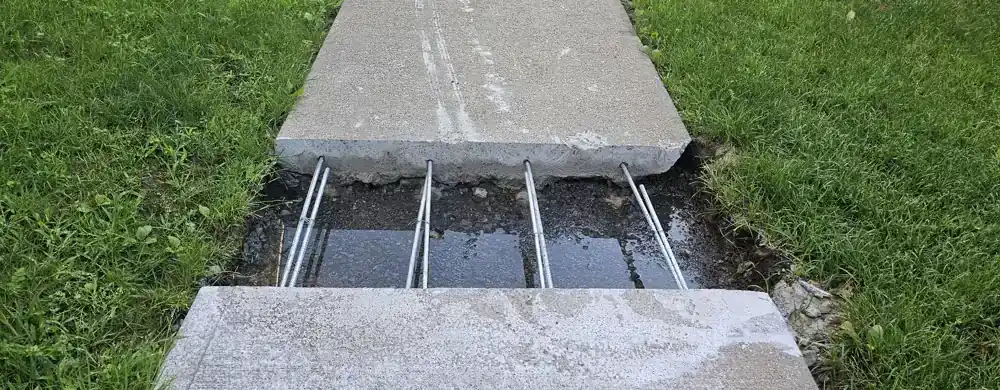
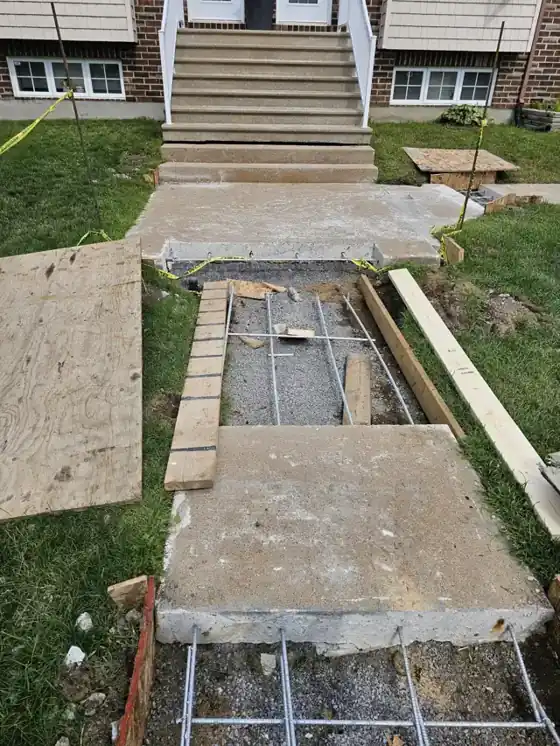
- Section removed through its full thickness, base evaluated and corrected, galvanized reinforcement where required, new concrete.
- When it is appropriate
- When the underlying concrete has lost substantial integrity.
- What to watch
- More work up front; the section is closed during curing.
- Cost
- Higher initial cost; often the most durable and economical long-term solution.
Initial cost vs long-term value
Why a two-inch surface repair is not always the most economical solution
A partial-depth repair can be an effective solution when the remaining concrete is sufficiently sound. However, when deterioration extends deeper into the slab, removing only the upper two inches may leave weakened material beneath the new repair.
Although a shallow repair may initially cost less than full-depth reconstruction, repeated deterioration can make it less economical over time. Our practical experience has shown the importance of evaluating the complete damaged section rather than focusing only on the visible surface.
Our goal is not simply the lowest initial repair cost. It is the most technically appropriate and economically justified solution for the condition of the concrete.
Advanced concrete repair materials
We do not use one universal repair mortar
Polymer-modified cementitious mortars
Cement-based materials enhanced with polymers to improve adhesion, flexibility, mechanical performance and durability, depending on the formulation. Suitable for localized repairs and surface restoration on properly prepared concrete.
High-strength concrete mixes
Mixtures selected for the required compressive strength and durability. Used for deeper repairs and full-depth sidewalk reconstruction.
Fiber-reinforced repair mortars
Cementitious materials containing reinforcing fibers that help control certain types of cracking and improve selected mechanical properties.
Rapid-setting repair systems
Formulated to gain strength faster than conventional systems — useful when pedestrian access restrictions must be reduced, provided curing and return-to-service requirements are met.
Low-permeability repair materials
Cementitious formulations designed to reduce water and chloride penetration, supporting improved durability under the right exposure conditions.
Selected for actual conditions
The best repair system is not necessarily the most expensive material, but the one correctly selected for the application. See the criteria below.
Material selection
What we consider before selecting a repair material
Not all concrete repairs require the same material. We select the system according to the existing concrete condition, repair depth, structural requirements, environmental exposure and expected service conditions.
- Depth and extent of deterioration
- Condition and strength of the existing substrate
- Bonding requirements
- Mechanical and pedestrian loading
- Moisture exposure
- Freeze-thaw resistance
- De-icing salt exposure
- Repair thickness
- Reinforcement requirements
- Curing and service conditions
Galvanized steel reinforcement
Galvanized rebar and mesh: strength and corrosion protection
For concrete sidewalk sections requiring reinforcement, Delta Waterproofing uses galvanized steel reinforcing bars and galvanized steel mesh where specified or technically appropriate.
Galvanized steel is protected by a zinc coating that improves corrosion resistance compared with conventional uncoated carbon steel — a benefit in exterior concrete exposed to moisture and de-icing salts.
When properly designed and installed, galvanized rebar helps distribute tensile forces and control cracking. Properly specified and positioned galvanized mesh provides distributed reinforcement that helps control shrinkage-related cracking.
Reinforcement type, spacing, anchorage and concrete cover must be appropriate for the project: we consider both the quality of the concrete and the reinforcement within it.
Full-depth sidewalk restoration
Removing the deterioration instead of covering it
- 01Concrete assessmentCracks, delamination, deterioration and condition of the existing concrete.
- 02Full-depth removalDemolition and removal of the deteriorated section.
- 03Base and subgrade evaluationGranular base, drainage and support conditions.
- 04Base preparationCorrection of unsuitable support conditions.
- 05ReinforcementGalvanized rebar or mesh where required by the design.
- 06Material selectionA concrete mix or repair material suited to the reconstruction.
- 07Placement and finishingAppropriate surface profiling and finish.
- 08Curing and final inspectionProper curing and verification before returning to service.
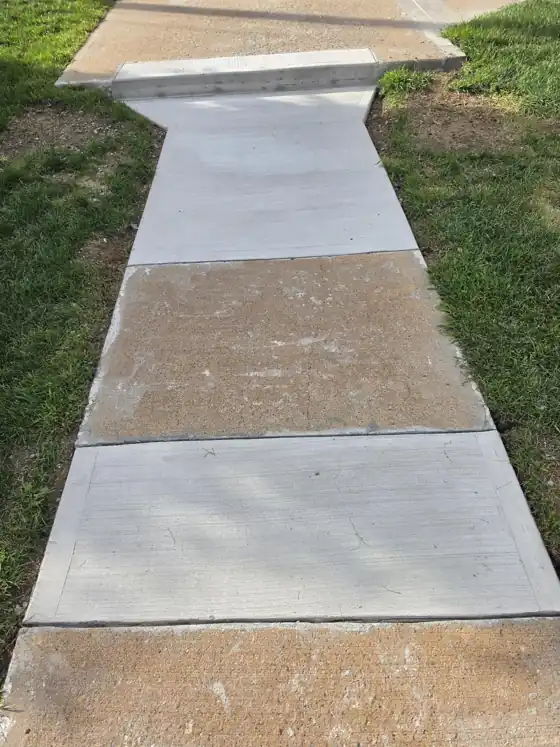
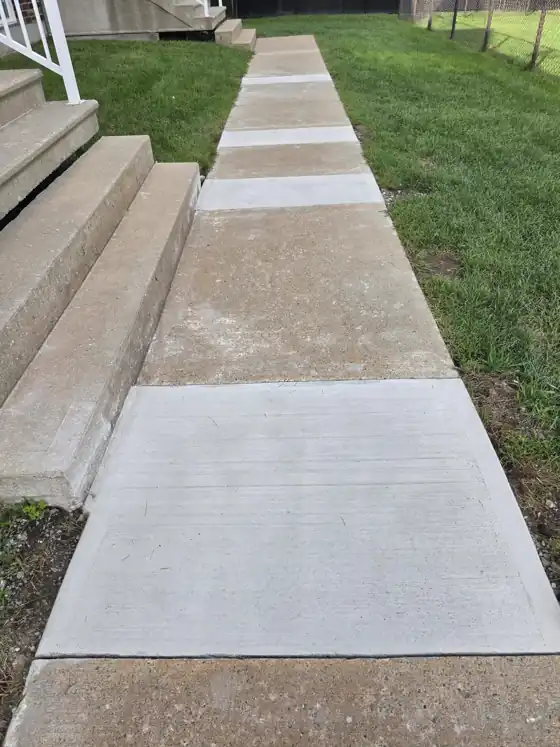
Full-depth sectional restoration reduces the risk of leaving severely deteriorated concrete beneath a new repair surface. It is particularly appropriate when the remaining concrete cannot reliably support a partial-depth repair.
We don’t just repair the surface. We address the deterioration beneath it.
Sidewalk crack repair
Understanding the cause before selecting the solution
Not all cracks require the same treatment: stable cracks, moving cracks and cracks associated with settlement may need different repair strategies. We evaluate the crack and the surrounding concrete before selecting a material.
Depending on the condition, repairs may involve specialized cementitious materials, compatible resin-based systems, flexible joint treatments or reconstruction of the affected section. Where cracking indicates extensive deterioration, full-depth restoration is often more appropriate than localized crack filling.
- Drying shrinkage
- Temperature changes
- Settlement
- Inadequate base support
- Freeze-thaw deterioration
- Mechanical loading
- Movement at joints
- Existing concrete defects
Water, de-icing salts and freeze-thaw
Concrete repair systems designed for Quebec’s climate
Exterior concrete in Montreal, Laval and Longueuil faces challenging seasonal conditions: repeated freezing and thawing, moisture penetration and winter de-icing products accelerate deterioration. That is why material selection is a critical part of our process.
The selected material must be compatible with the existing substrate and appropriate for the anticipated exposure — no single product suits every application. Our waterproofing experience gives us insight into the relationship between moisture, exposure and concrete deterioration.
Proper preparation, suitable materials, reinforcement where required and correct curing: this combination is what supports long-term performance.
- Freeze-thaw durability
- Resistance to de-icing salts
- Reduced water permeability
- Mechanical strength
- Bonding performance
- Abrasion resistance
- Dimensional stability
Who we work for
Residential, commercial, industrial and institutional
Residential
Concrete sidewalks and walkways for single-family homes, residential buildings, condominiums and pedestrian access areas.
Commercial
Restoration of sidewalks and walkways around office buildings, retail properties and commercial entrances.
Industrial
Pedestrian walkways and access areas at industrial facilities, warehouses and operational properties, with materials selected for the project.
Institutional
Concrete pedestrian surfaces at schools, administrative buildings and other institutions, subject to applicable specifications.
Our repair process
Assess. Select. Prepare. Repair. Verify.
- 01Inspection and assessmentVisible deterioration, concrete condition, crack patterns and exposure.
- 02Repair strategy selectionCrack repair, partial-depth or full-depth reconstruction.
- 03Removal and preparationUnsound concrete removed, substrate or base prepared.
- 04Reinforcement where requiredGalvanized rebar or mesh as specified by the repair design.
- 05Repair or reconstructionPer project requirements and manufacturer specifications.
- 06Finishing and curingAppropriate texture, cured per the selected system.
- 07Final inspectionCompleted work reviewed before return to service.
- 08Return to serviceThe area reopens once curing requirements are met.
Why Delta
Why choose Delta Waterproofing as your concrete sidewalk contractor
Concrete sidewalk repair cost
Extent and depth of deterioration, repair method (crack, partial-depth or full-depth), base condition, reinforcement, materials, access and finishing. A free on-site assessment gives you a written quote.
Get the priceFAQ
Concrete sidewalk repair questions
Related services
Can a damaged concrete sidewalk be repaired without replacing the entire slab?
Yes. Localized repairs can be effective when the existing concrete remains sufficiently sound. Extensive deterioration may require full-depth sectional reconstruction.
Is polymer-modified repair mortar better than regular concrete?
Polymer-modified repair mortars can offer advantages such as improved adhesion and selected durability properties. However, the best material depends on repair depth, substrate condition, exposure and application requirements.
Why do some sidewalk repairs fail after only a few winters?
Premature deterioration may result from inadequate surface preparation, unsuitable repair materials, insufficient curing, moisture exposure, freeze-thaw damage or continued deterioration of the original concrete beneath the repair.
Is replacing a complete damaged sidewalk section better than repairing the top two inches?
When the underlying concrete is severely deteriorated, full-depth sectional reconstruction may provide a more reliable and economical long-term solution. Partial-depth repairs remain appropriate when the underlying concrete is sound.
Why use galvanized steel reinforcement?
Galvanized steel reinforcement provides additional corrosion resistance compared with uncoated carbon steel and can be beneficial in appropriately designed concrete sections exposed to moisture and de-icing salts.
What types of concrete repair materials do you use?
Depending on the project, repair methods may incorporate polymer-modified cementitious mortars, high-strength concrete mixes, fiber-reinforced repair mortars, rapid-setting systems and other specialized restoration materials.
Do you repair commercial, industrial and institutional sidewalks?
Yes. Delta Waterproofing provides concrete sidewalk and walkway repair for residential, commercial, industrial and institutional properties throughout Montreal, Laval and Longueuil.
Free on-site estimate
Request a professional concrete sidewalk repair estimate
Sidewalk crack repair, localized restoration or full-depth sectional reconstruction: we provide solutions based on the condition of the existing concrete. Send us photos or book a free assessment.
RBQ 5762-6723-01 · $5M liability insurance